Showing posts with label agriculture. Show all posts

Friday, October 12, 2012

Curbing food security : Agricultural Industrialization

The most authentic means of aid to Ghana or Africa must be in such a form devoid of the usual politics or a minimal political influence.Honestly,money given is always lopsided to those in higher positions. What must be done? Creating long-lasting solutions should be the bottle-neck even if its hard and difficult.Teaching local farmers the need for tractors and assisting them in the process to  secure some basic equipments is most relevant.

In the 21st century,most farmers in Ghana and Africa still use cutlasses and hoes for work.How many acres and how many days will they have to toil to produce two acres of corn/maize?

In the videos below,Mr. Balle and his friends from Denmark did the most important thing by building a farm in Ghana with the assistance from local workers.You can imagine what a few tractors and harvesters can do in few days. This is the path Ghana and Africa must take,to gradually produce enough to ensure food security.

The current record of 52% work force in agriculture producing about 25% of what the country really needs is wrong.




Tuesday, June 12, 2012

Ghana : Climate Change and Food Security

An increased body of evidence shows that climatic variability is  adversely affecting Ghana’s natural resources such as land, water, forests and vegetation, as well as human capital.

Climate change is, therefore, expected to have significant impact on key resource-dependant sectors, such as agriculture and food production, and consequently on food security.

Food security is under threat from unpredictable changes in rainfall and more frequent extreme weather.

FOOD INSECURITY
Recent statistics show that a total of 1.2 million Ghanaians are with limited access to sufficient and nutritious food throughout the year, whiles another 2 million are at risk or becoming food insecure during the lean season or at the onset of a natural or man-made disaster.>>> continue >>>

Sunday, February 12, 2012

Food Security ; Ghana’s agric sector must be transformed

A lot has been said about Ghana’s economy and the need to boost agricultural production to feed the nation, provide jobs for the people, stem rural-urban migration, reduce poverty and enhance the nutritional needs of citizens. Sadly enough, little concerted effort has been made by governments and stakeholders over the years to significantly develop the nation’s agricultural industry.

Ghana has more arable land than most Western European countries yet the country imports agricultural products from these countries. Ghana is a net importer of almost every agricultural product ranging from rice, wheat, soya bean, corn, poultry products (turkey tail, chicken, etc), fish and fish products, beef, pork, pig feet, cow feet etc. The country cannot continue to apply piecemeal approaches to solving this very essential food importation problem. Over the years governments have been in a hurry to implement various intervention programmes different from those implemented by predecessor governments. Interestingly all the interventions are either short termed or not sustained long enough to ensure that results are achieved.>>continue>>


Monday, September 12, 2011

Addressing Ghana’s agriculture challenges

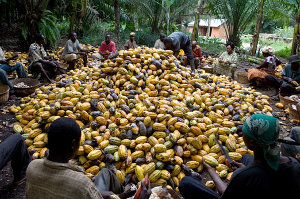
CocoaGhana’s increasing population, changing weather patterns and global food price hikes are squeezing the budget of the less well-off. Although agricultural production has grown at over 5% annually since 2001, this has largely been achieved by bringing new land into cultivation. Yield gaps between Ghana’s productivity levels, compared to what is achievable, are far too high.

Ghana's cocoa farmers have enjoyed higher incomes for the current cropping season and interventions are underway to improve soil fertility.

Adopting a business-as-usual approach to agriculture in Ghana is really not an option if long-term and sustainable food security is to be achieved. But already, Ghana commits almost 10% of its annual budget to improving agriculture, placing it top of the list of investors in the sector in Africa. Added to this, Ghana’s spending on agricultural research and development more than doubled between 2002 and 2008.>>>continue