Monday, September 10, 2012

Access to water key for food security: FAO chief

FAO director-general Jose Graziano Da Silva 

STOCKHOLM — Global food security starts with ensuring access to water, the head of the Food and Agriculture Organisation (FAO) said at the beginning of World Water Week Monday.
"There is no food security without water security," said FAO director-general Jose Graziano Da Silva in Sweden, which is hosting the annual event organised by the Stockholm International Water Institute (SIWI).
With crop growing hampered by the effects of pollution and climate change, agriculture must become "more efficient and fairer", he said, adding that nations all over the world need to "produce more with less" and manage water resources well.
The conference, whose theme is water and food security, also heard from Swedish Cooperation Minister Gunilla Carlsson who urged the business world to find fresh ideas and new partners to help improve food security.>>more

Monday, July 9, 2012

Ghana: Food Security, Climate Change and Global Resource Scarcity

Global demand for food will double in coming decades, through population growth and rising levels of consumption. Ensuring the planet produces enough food for all in a sustainable way will be a real challenge, and climate change will hamper our efforts if it is not tackled.

Food security is crucial to helping the poorest countries help themselves out of poverty. This is why the United Kingdom is leading on making food security an issue that is discussed at a global level. Starting at the upcoming G-8 summit, we will help launch a new alliance to lift 50 million out of poverty over the next ten years, using private sector investment to help people achieve the food security we all take for granted in the U.K.

For nearly 50 years, there were grain mountains in Europe and North America, with prices at historic lows. Yet hundreds of millions of people still faced chronic hunger and malnourishment, which blighted generation after generation of children. One in three Africans still go hungry today, in a world of plenty, so it is vital we help the poorest people access the food that is available.>>>more

Wednesday, July 4, 2012

Common Agricultural Policy (CAP) and Trade Liberalization

My Take : The CAP which subtly underlines European trade with other developing countries like Ghana is the main course of trade imbalance and the primary reason why Ghana must beware of the Economic Partnership Agreement.Whiles EU seeks access to african markets at lower costs for their produce,they reciprocate these with many blockages to disallow access from other developing countries..

The CAP is a form of protectionism designed to defend European producers from cheaper products outside the EU. This was once done by subsidising agricultural produce but is now achieved by the EU deterring imports from outside the EU with a system of import tariffs and simultaneously subsidising farmers through the Single Farm Payment. >>> more

Tuesday, June 12, 2012

Ghana : Climate Change and Food Security

An increased body of evidence shows that climatic variability is  adversely affecting Ghana’s natural resources such as land, water, forests and vegetation, as well as human capital.

Climate change is, therefore, expected to have significant impact on key resource-dependant sectors, such as agriculture and food production, and consequently on food security.

Food security is under threat from unpredictable changes in rainfall and more frequent extreme weather.

FOOD INSECURITY
Recent statistics show that a total of 1.2 million Ghanaians are with limited access to sufficient and nutritious food throughout the year, whiles another 2 million are at risk or becoming food insecure during the lean season or at the onset of a natural or man-made disaster.>>> continue >>>

Tuesday, April 17, 2012

Ensuring Food Security For Ghanaians

Food security is one of the most relevant things that every nation should be conscious of and prioritize it to a mechanism to tackle the unforeseen situation as far as food security is concerned. Many countries have failed to tackle this particular issue with great concerned and as a result of that keep battling with the consequences.


Specifically, Africa has been one of the continent battling with this situation and has an increasing population increasing every time and then. Food security itself exists when all people, at all times have access to safe and nutritional food at affordable prices to meet their dietary and food preference for an active and wealthy life.>>>more>>>

Sunday, February 12, 2012

Food Security ; Ghana’s agric sector must be transformed

A lot has been said about Ghana’s economy and the need to boost agricultural production to feed the nation, provide jobs for the people, stem rural-urban migration, reduce poverty and enhance the nutritional needs of citizens. Sadly enough, little concerted effort has been made by governments and stakeholders over the years to significantly develop the nation’s agricultural industry.

Ghana has more arable land than most Western European countries yet the country imports agricultural products from these countries. Ghana is a net importer of almost every agricultural product ranging from rice, wheat, soya bean, corn, poultry products (turkey tail, chicken, etc), fish and fish products, beef, pork, pig feet, cow feet etc. The country cannot continue to apply piecemeal approaches to solving this very essential food importation problem. Over the years governments have been in a hurry to implement various intervention programmes different from those implemented by predecessor governments. Interestingly all the interventions are either short termed or not sustained long enough to ensure that results are achieved.>>continue>>


Tuesday, January 3, 2012

Interview: Financing cocoa in Ghana

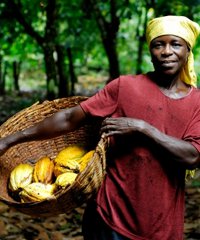
Cocoa farmerStanbic Bank Ghana this week confirmed that a record number of commitments have been secured for Ghana Cocoa Board’s 17th annual pre-export finance facility. Standard Bank was one of the joint mandated lead arrangers (MLAs) for the US$1.2 billion transaction along with Crédit Agricole, ICBC, Ghana International Bank and SMBC.

Ghana's cocoa industry consists of thousands of small-scale farmers.
The transaction was oversubscribed at US$1.834 billion, and the borrower increased the facility size to US$1.5 billion. A total of 28 banks, including the MLAs, confirmed participation, with ticket sizes following scale-backs ranging from US$5 million to US$100 million.

The structure of this deal remains unchanged, with the facility used to purchase cocoa beans for the 2010/11 season, and secured by the assignment of export contracts from overseas buyers.>>>more>>>